
Making workplace training easier to build.
- My role
- Founder
- Timeline
- 2024 - Present
"Most learning platforms treat course creation as a necessary chore. I believed training could be fundamentally different."
Challenge
Small teams need to train people, but rarely have a dedicated learning team. The person creating a course is often doing it alongside another job, with knowledge scattered across documents, slides, and experience.
Solution
Bring AI assistance, course structure, visual editing, and assessments into one workflow. Start with a simple draft, keep everything editable, and introduce more powerful tools when they become useful.
Results
- A launched platform used for onboarding, compliance, and course sales
- A single AI assistant across course creation and editing
- A simpler starting point, with branching available as a course grows
The hard part was getting started.
After years of building education and immersive technology, I kept coming back to the same frustration: learning tools made it easier to manage training than to create something worth learning from.
I founded Konstantly to close that gap. My work spans the product direction, the interface, and the engineering behind it. The challenge has been to make a capable platform feel approachable to someone building their first course.
Product direction
Choosing the audience, the problem, and what to simplify.
Design & interaction
Connecting the first prompt to a course people can actually use.
Engineering & iteration
Building the product and improving it as the work reveals what matters.
Start with intent.
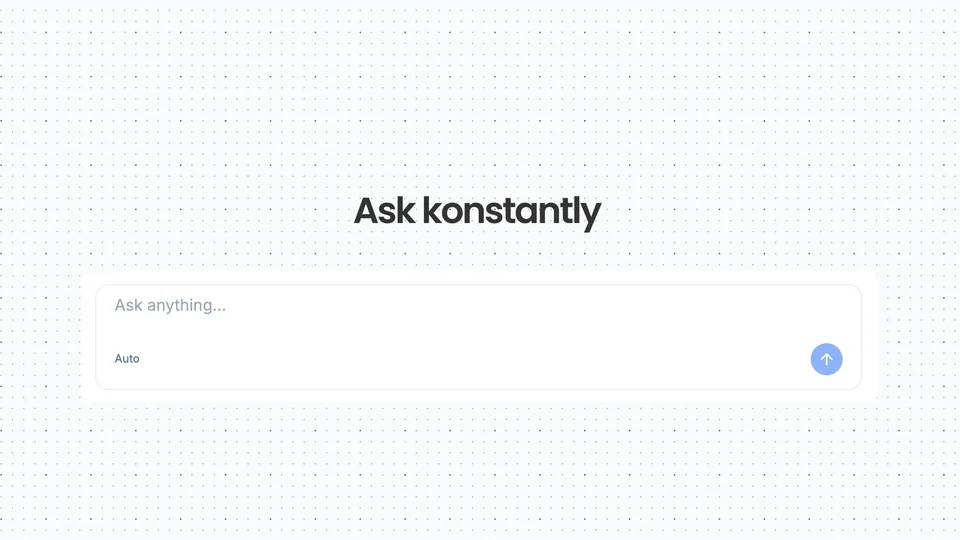
The first step should be describing what you want to teach. Ask Konstantly turns that brief into a course draft, asks for context, and lets the author refine it in the same conversation.
I brought that assistance into the course builder and editors too. The author can keep working on the same material, with the same assistant, instead of learning a separate AI tool for every task.
AI gets the first draft moving. The author stays in control.
Make the simple path the starting point.
An early version asked people to choose between a linear course and a visual canvas before they had written anything. It was a product decision disguised as a setup question. People had to understand the tool before they could use it.
I changed that. Start with a sequence of pages, lessons, and tests. Add branching when a learner's next step actually needs to depend on an answer or a result. The canvas becomes useful at the moment the course needs it.
Returning to a simple sequence should be possible when no learning logic is lost. That constraint matters: simplifying the interface should never silently change the author's course.
A draft should feel like a beginning.
Generating content is only useful if the author can make it their own. I rebuilt the editor around direct manipulation: text, images, video, and other elements on one canvas, with a preview close at hand.
The work here was in the details. Adding an image, moving a block, or adjusting a lesson should feel like working on the content itself. The interface needs to support the person doing the teaching.
Check understanding. Then improve the course.
A completed lesson does not tell you whether someone understood it. Assessments need to fit the skill being taught: a choice, a sequence to put in order, items to match, or an answer that needs the learner's own words.
AI can help draft the questions, but the author still needs to review the wording and decide what a good answer looks like. That is why generation and editing belong in the same workflow.
On the other side of that work, analytics help a team see participation and completion. Bringing those signals back to the author closes the loop between publishing training and making it better.
Simplicity is a series of decisions.
I initially made the interface too unfamiliar and asked people to understand too much up front. The biggest improvements came from revisiting those decisions: one assistant, a simpler starting point, and room to grow without starting over.
Choosing a clearer audience mattered just as much. Konstantly is for teams creating training themselves, often without a dedicated learning department. That shapes both the product and how people get started: published pricing, a free entry point, and a path from a first draft to a working course.
It is a live product that I am still building. My responsibility is to keep the whole experience coherent, from the promise on the website to the small interaction inside an editor.
Explore the product behind the story.
Visit Konstantly